
Marble countertop care is more honest than most fabricators let on. Marble etches, develops patina, and behaves differently than granite or quartz — and if you’re buying it for a working kitchen, you need to know what you’re signing up for. Done right, the tradeoffs are worth it. Done wrong, you’ll spend years frustrated by a beautiful material that never got a fair chance.
Caring for marble countertops is a key concern for Columbus homeowners who want their investment to last.
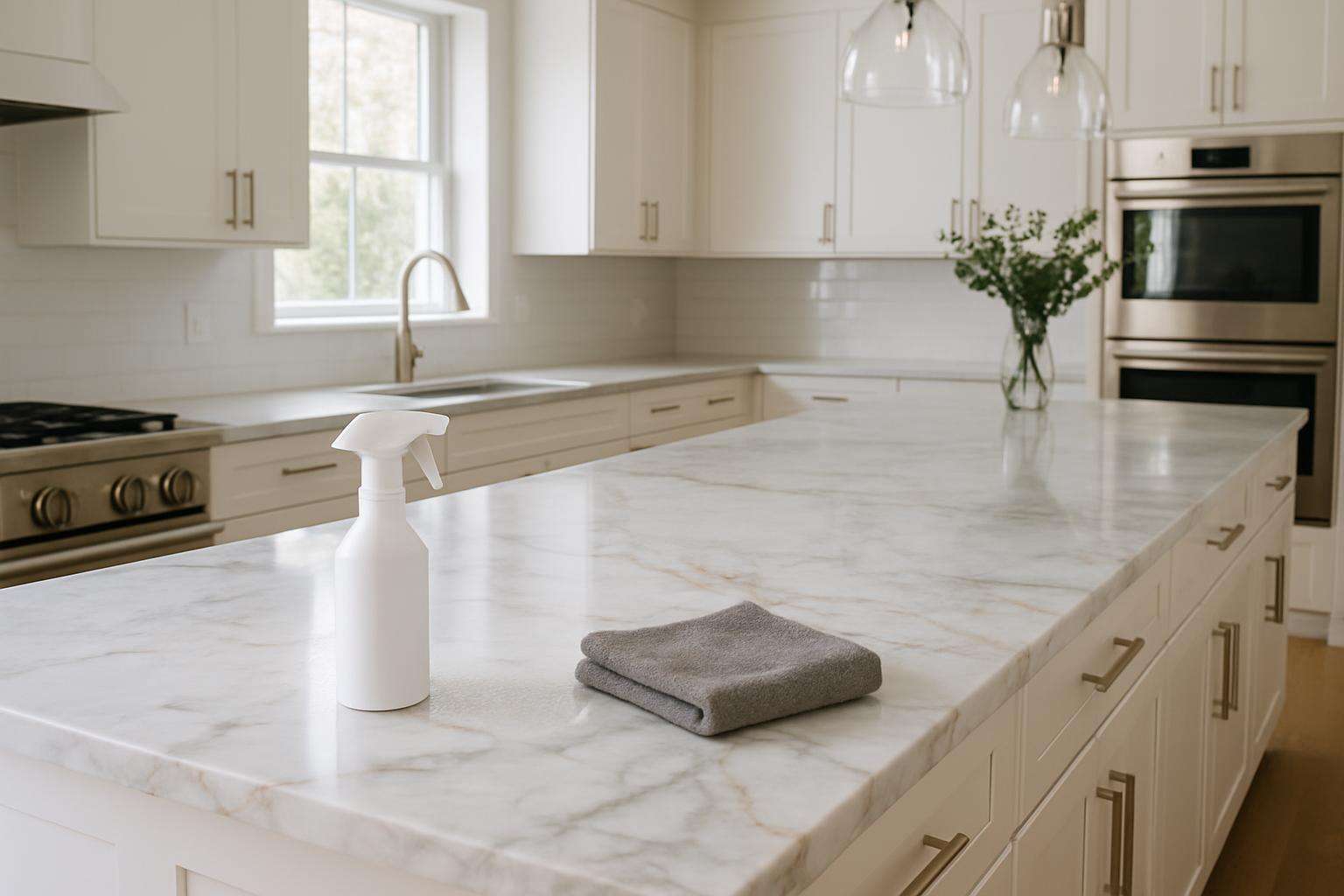
What etching actually is — and why marble countertop care can’t ignore it
Etching is a chemical reaction, not a physical scratch. When acidic substances — lemon juice, vinegar, wine, tomato, many household cleaners — contact marble, they react with the calcite in the stone and leave a dull, lightened mark on the polished surface. Wiping it up doesn’t reverse it. The damage has already happened at the molecular level.
This is the single most important fact about marble countertop care. Sealing helps with staining, but it doesn’t prevent etching — sealers are designed to block liquid absorption, not stop acid reactions. A freshly sealed marble surface can still etch.
The practical implication: spills from citrus, wine, coffee, and acidic cleaners need to be wiped up in seconds, not minutes. Kitchens that see heavy prep work with acidic ingredients will develop etch marks over time. That’s a design decision, not a maintenance failure.
Marble patina: the other side of marble countertop care
Patina is what happens when marble is used. Over time, the surface develops micro-scratches, a slight softening of the polish, and a lived-in quality that many homeowners actually prefer to a brand-new slab. This is a feature in traditional kitchens, Italian farmhouses, and historic homes — not a bug.
Caring for marble countertops represents one of the most important decisions Columbus homeowners face when selecting stone surfaces. Understanding caring for marble countertops helps ensure long-term satisfaction with your kitchen investment.
The distinction matters for marble countertop care strategy. If you’re chasing a pristine, showroom-perfect surface indefinitely, marble will disappoint you on a working kitchen island. If you’re fine with — or actively want — a surface that shows its age beautifully, marble delivers that authentically in ways engineered materials can’t replicate.
Honed marble, which has a matte rather than polished finish, is more forgiving on this front. Etch marks are less visible on a matte surface because there’s less contrast between the dull etch and the surrounding finish. For kitchens where daily use is expected, honed is often the more practical choice.
Daily marble countertop care: the actual routine
The daily routine is simple: warm water, a few drops of pH-neutral dish soap, a soft cloth. That covers everyday cleaning. Don’t overcomplicate it.
What to avoid:
- Vinegar or citrus-based cleaners — they etch the surface and are probably the most common cause of unintentional damage in marble kitchens
- Bleach and ammonia-based products — they degrade the stone’s finish over time
- “Stone cleaners” from the grocery store — many contain acids or surfactants that aren’t appropriate for marble; use products formulated specifically for calcareous stone
- Abrasive pads or scrubbers — they scratch the polished surface
Dry the surface after cleaning rather than letting water pool and evaporate. Hard water leaves mineral deposits that are harder to remove once dried.
Sealing: what it does and doesn’t do
Sealing marble annually with a penetrating stone sealer reduces staining risk by filling the stone’s pores and slowing liquid absorption. It’s worth doing — unsealed marble stains readily from oils, red wine, and pigmented liquids.
But sealing doesn’t prevent etching. This distinction gets lost constantly. Homeowners who seal their marble and assume it’s fully protected are the ones most surprised when a lemon wedge leaves a mark within minutes of contact.
To test whether your seal is holding: put a few drops of water on the surface and watch. If it beads and sits for several minutes, you’re good. If it darkens quickly and absorbs, it’s time to reseal. The test takes thirty seconds.
The Natural Stone Institute’s care guidelines cover sealer types and application frequency by stone type in detail.
What marble is actually well-suited for
Marble performs best in applications where aesthetics matter more than daily utility under heavy use:
- Bathroom vanities — lower traffic, no food prep, minimal acid exposure; marble performs beautifully here
- Fireplace surrounds — no food contact, no moisture, full visual impact; an ideal application
- Baking stations — marble’s natural coolness is genuinely useful for pastry work, and bakers who understand the material tend to care for it well
- Lower-use kitchen islands — in homes where the kitchen is more for presentation than heavy cooking, marble delivers a look that quartzite and quartz can’t fully replicate
For a primary island in a household that cooks seriously — daily prep, lots of citrus and wine, kids — granite or a dense quartzite is the more forgiving choice. That’s not a knock on marble; it’s matching the right material to the project.
Comparison at a glance
| Characteristic | Marble | Granite | Quartzite |
|---|---|---|---|
| Etching from acids | Yes — wipe spills immediately | No | Possible (varies by slab) |
| Sealing needed | Yes, annually | Yes, annually | Yes, annually (sometimes more) |
| Patina over time | Yes — develops character | Minimal | Minimal |
| Best applications | Vanities, fireplaces, baking stations | High-use kitchens | Kitchens, statement islands |
| Daily cleaner | pH-neutral soap + water | pH-neutral soap + water | pH-neutral soap + water |
For more on caring for marble countertops, the Natural Stone Institute provides authoritative industry guidance. To discuss caring for marble countertops with our team, contact Impact Countertops in Columbus.
FAQ
Caring for marble countertops: Does marble always etch?
Yes — all marble contains calcite, which reacts with acids. The degree depends on the acid concentration and contact time. A quick splash of lemon juice may leave a faint mark; a pooled spill left for several minutes will leave a noticeable one. Light etching on polished marble can sometimes be addressed with marble polishing powder. Deep etching usually requires professional refinishing.
Can you fix etch marks on marble countertops?
Light etching on polished marble can often be buffed out with a marble polishing powder — it’s a mild abrasive that re-establishes the shine on the affected area, and it’s a project most homeowners can handle with patience and the right product. Deep etch marks, or widespread surface dulling, require professional honing and re-polishing. Honed marble shows etch marks far less clearly, which is one reason many fabricators recommend matte finishes for kitchen applications.
How often should marble countertops be sealed?
Once a year is the standard recommendation, though more porous marbles may benefit from sealing twice a year. The water-drop absorption test is the best guide: if water beads on the surface for several minutes, the seal is holding. If it absorbs quickly or leaves a dark ring, it’s time to reseal. This is a 20-minute project most homeowners can do themselves with a quality penetrating stone sealer.
Is honed marble better than polished for kitchens?
Honed marble hides etch marks better than polished marble. Etching reduces the surface sheen — on a high-polish surface, the dull spot is visible against the gloss; on a matte surface, the contrast is much less obvious. Honed marble does show fingerprints and smudges more readily than polished. Neither finish is “better” — it depends on how much you cook, how quickly you wipe spills, and which look you prefer. Many clients planning a statement kitchen island prefer honed precisely because they intend to actually use it.
What’s the difference between marble patina and damage?
Patina is the gradual softening and deepening of the stone’s character through use — micro-scratches that diffuse light slightly differently, a gentle mellowing of the polish, an overall warmth that brand-new slabs lack. It’s similar to how quality leather ages. Damage is something different: deep scratches, significant etching, chips, or staining that goes beyond normal wear. With consistent marble countertop care, the line between the two stays wide. Neglect closes that gap quickly.
If you’re considering marble for a kitchen island, vanity, or fireplace surround in a Columbus home and want to see how a specific slab will lay out before committing, our digital slab preview shows exactly how the stone looks in your space. Reach out and we’ll walk you through what’s in stock and which finish suits your project.




Leave a Reply