
Comparison · Columbus, Ohio
Quartzite vs Quartz in Columbus, Ohio
A boutique fabricator’s side-by-side guide to natural quartzite and engineered quartz — what they are, how they behave, and which one belongs in your kitchen, bath, or build.
Why This Page Exists
Two Materials, Constantly Confused
Quartzite and quartz sound nearly identical and they sit next to each other in every showroom, but they are not the same material. One is a natural stone formed under pressure over millions of years. The other is an engineered surface manufactured from crushed minerals and resin. They behave differently, age differently, and price differently. This page is the straight comparison we walk Columbus homeowners through in our showroom every week.
At a Glance
The Four Differences That Matter Most
Origin
Quartzite
Natural stone, quarried from sandstone metamorphosed under heat and pressure
Quartz
Engineered surface, ~90% crushed quartz minerals bound with resin and pigment
Hardness
Quartzite
7 on the Mohs scale — harder than granite, very scratch-resistant
Quartz
7 on Mohs for the quartz mineral; the resin binder is softer than the stone itself
Heat
Quartzite
Excellent — tolerates hot pans without damage in most varieties
Quartz
Moderate — sustained heat can scorch or discolor the resin binder
Maintenance
Quartzite
Sealed once or twice a year, otherwise wiped clean like granite
Quartz
No sealing — non-porous from the factory, wipe clean
Side by Side
Quartzite vs Quartz: How Each One Actually Performs

Natural Stone
Quartzite
- Real natural stone with movement that never repeats slab to slab.
- UV-stable — safe for sunlit kitchens and outdoor kitchens.
- Heat-friendly for serious cooks; hot pans rarely cause damage.
- Slightly porous — sealing once or twice a year keeps stains out.
- Each slab is unique, so you select the actual slab in person at our partner showrooms.
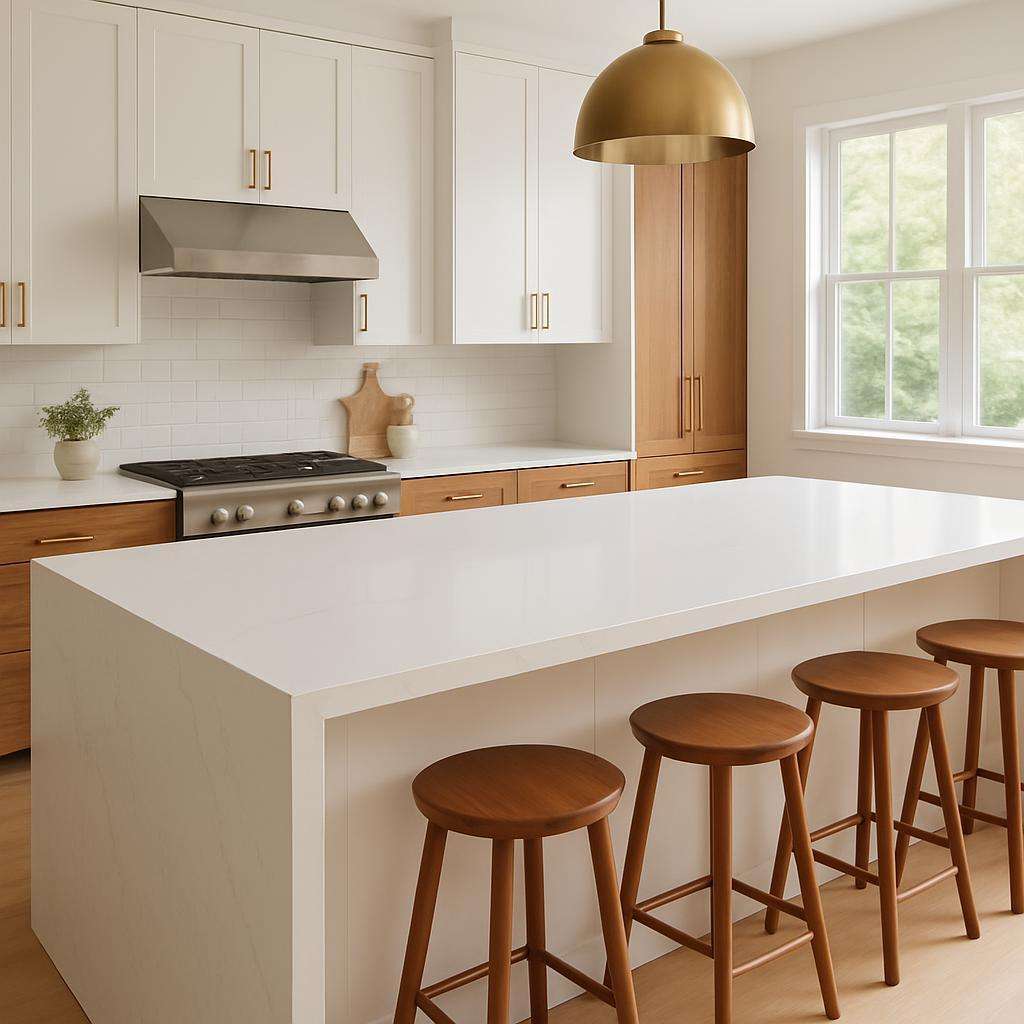
Engineered Surface
Quartz
- Engineered consistency — what you see on the sample is what arrives.
- No sealing required, non-porous, very forgiving with red wine and coffee.
- Not UV-stable in most brands — avoid full-sun windows and outdoor use.
- Heat-sensitive resin binder — trivets required for hot cookware.
- Pattern repeats across slabs; great for a predictable, uniform look.
When Quartzite Wins
Pick Quartzite If You Want...
…a real natural stone with one-of-a-kind movement and depth, the kind of slab that becomes the focal point of a Columbus kitchen. Quartzite is the right call when the install includes full-height backsplashes, waterfall islands, vein-matching across a seam, or book-matched bookmatched layouts. It is also the right call when the space gets serious sunlight, when the kitchen does a lot of high-heat cooking, or when you want the surface to read as natural at every angle. Most of the dramatic stone installs in luxury Columbus homes — Upper Arlington, New Albany, Dublin, Powell, Bexley — are quartzite or marble, not quartz.
When Quartz Wins
Pick Quartz If You Want...
…low-maintenance consistency, predictable pattern, and no sealing routine. Engineered quartz is a smart pick for rental properties, secondary bathrooms, laundry rooms, and busy households where someone always leaves a glass of red wine on the counter overnight. It is also the right call when the design calls for a clean, uniform field with no movement — modern flat-front kitchens, minimalist baths, commercial work. Quartz is not the right call for sunlit kitchens (most brands yellow), for outdoor kitchens (not UV-stable), or for serious cooks who set hot pans directly on the surface.
How We Approach the Choice
A Boutique Fabricator's Take
Impact Countertops is a boutique fabricator focused on natural stone — quartzite, marble, granite, porcelain, soapstone. We fabricate quartz as well, but it is not where our craft lives. When a Columbus homeowner is genuinely torn between quartzite and quartz, the right answer is rarely the same answer twice. We use Slabsmith digital templating and Park Industries CNC equipment to plan vein-matching, book-matched seams, and precision mitered edges on the stone before it ever moves to the saw — that level of layout work is what makes natural stone worth choosing in the first place. For discerning homeowners, designers, and builders, we walk the slab in person, plan the layout digitally, and deliver a white-glove install. If after that walkthrough quartz is the right answer, we will say so — honestly, that is part of being a boutique shop instead of a volume one.
Frequently Asked
Quartzite vs Quartz FAQ
Is quartzite more expensive than quartz?
Usually yes. Quartzite is a natural stone that has to be quarried, slabbed, and shipped, so the material itself runs higher per square foot than mid-range engineered quartz. High-end quartz brands (Cambria, Caesarstone Calacatta lines, Silestone N-Boost) can match or exceed entry-level quartzite. In Columbus, expect quartzite installs to run roughly 15 to 40 percent above mid-range quartz, with luxury slabs higher.
Which is harder, quartzite or quartz?
The quartz mineral inside both materials sits at 7 on the Mohs scale, so the raw mineral hardness is similar. In daily use, quartzite is more scratch-resistant because it is solid stone all the way through. Engineered quartz is also a hard surface, but the resin binder is softer than the mineral, so deep scratches from ceramic knives or heavy abrasion show up more on quartz.
Can I put a hot pan on quartzite? On quartz?
On quartzite, yes — most varieties tolerate hot pans straight off the stove without damage. On quartz, no — trivets are required. Sustained heat will scorch, yellow, or crack the resin binder in engineered quartz, and most manufacturer warranties exclude heat damage.
Does quartzite need to be sealed?
Yes. Quartzite is slightly porous and benefits from a penetrating sealer once or twice a year — a five-minute task with a soft cloth. Quartz does not need sealing because it is non-porous from the factory.
Is one better for a Columbus outdoor kitchen?
Quartzite. Most engineered quartz is not UV-stable and will yellow or discolor in direct sun, which is why every quartz manufacturer voids the warranty on outdoor installs. Quartzite is natural stone and handles sunlight, weather, and temperature swings without issue.
Which one shows fingerprints or water marks more?
Quartz, surprisingly. Polished engineered quartz in dark colors can show fingerprints and water spots more visibly than honed or leathered quartzite. Finish matters more than material here — if smudging concerns you, a honed or suede finish on either material hides daily marks better than a high polish.
Still Not Sure Which One?
Bring your plans, your inspiration photos, or just your questions. We will walk you through quartzite, quartz, and the natural stones in between — honestly, and without pressure.