
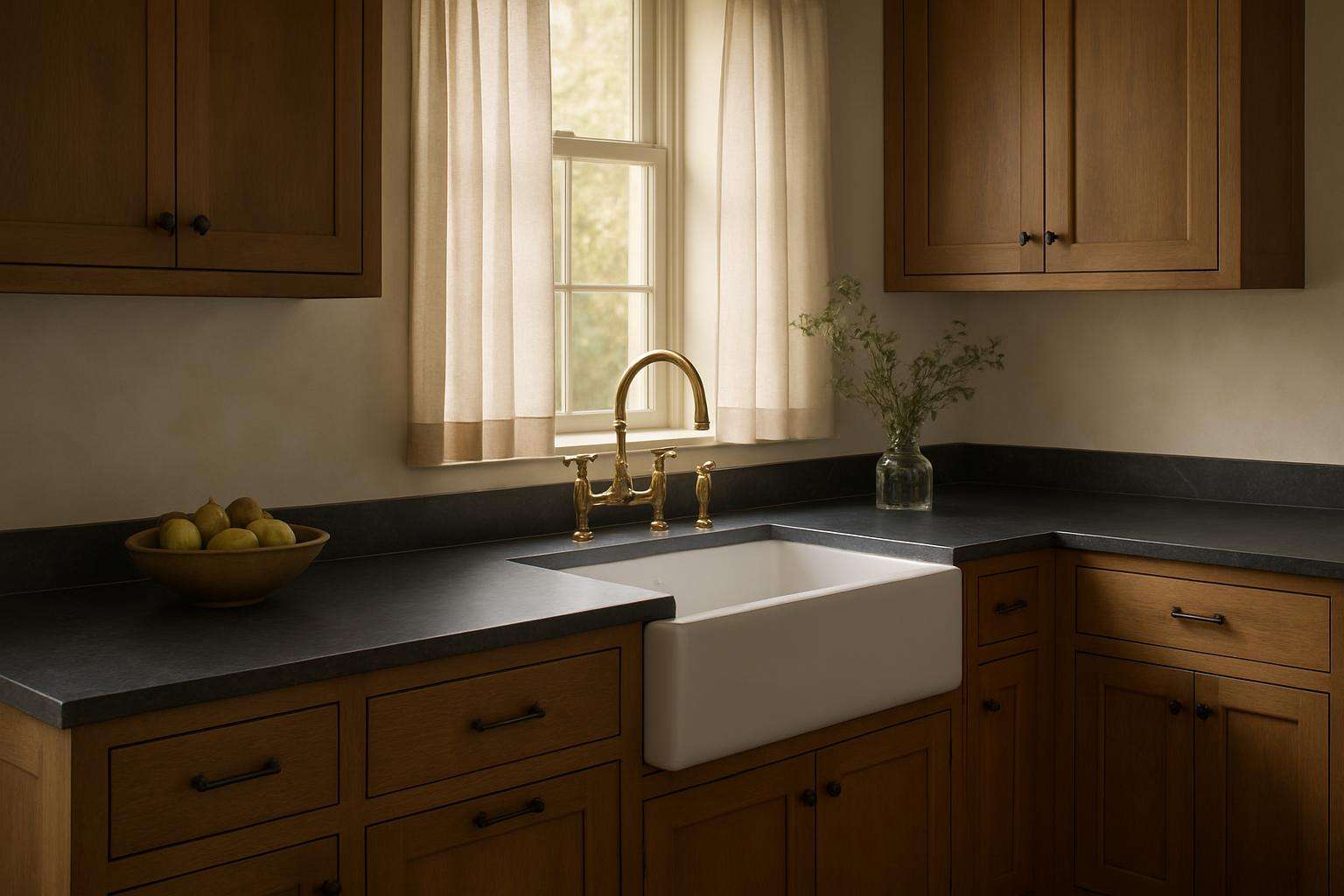
Soapstone is one of the oldest and most distinguished countertop materials in the world — used in everything from laboratory work surfaces to historic European kitchens — and it is experiencing a well-deserved resurgence among Columbus homeowners who value both authenticity and performance. With its distinctively dark, matte surface and natural warmth, soapstone brings an organic sophistication to kitchens that no manufactured material can fully replicate. But before choosing soapstone, it’s important to understand what makes it unique: a material with exceptional chemical resistance and distinct physical characteristics that require a slightly different approach to care than other natural stones. At Impact Countertops, we help clients understand exactly what to expect from soapstone so they can enjoy it confidently for decades to come.
What Is Soapstone?
Soapstone is a metamorphic rock composed primarily of talc — the same mineral that gives baby powder its silky texture — along with varying amounts of chlorite, magnesite, and dolomite. Its high talc content gives soapstone its characteristic softness and the slightly smooth, almost soapy feel from which it gets its name. Soapstone is quarried in several locations around the world, with notable sources in Brazil, Finland, and the United States. The Natural Stone Institute recognizes soapstone as one of the most chemically inert natural stones used in construction — a property that made it the preferred material for laboratory countertops and chemistry sinks for generations. This chemical resistance translates into excellent practical performance in residential kitchen settings as well.
The Durability of Soapstone Countertops
Chemical Resistance
Soapstone’s most remarkable durability characteristic is its near-total resistance to acids and alkalis. Unlike marble and limestone — which etch immediately on contact with acidic substances like lemon juice, vinegar, or wine — soapstone is chemically inert and will not etch, react, or be damaged by the acids and chemicals commonly encountered in a kitchen. This makes it exceptionally forgiving in food preparation environments where spills are inevitable and immediate cleanup isn’t always possible.
Non-Porous Nature
Soapstone is naturally non-porous, meaning liquids cannot penetrate its surface. Unlike granite, marble, or quartzite — which are porous to varying degrees and require periodic sealing — soapstone never needs to be sealed. Bacteria cannot colonize a non-porous surface, making soapstone a highly hygienic choice for kitchen countertops. Stains from oils, wine, coffee, and other pigmented liquids sit on the surface rather than soaking in, making cleanup straightforward.
Heat Tolerance
Soapstone has an excellent historical record as a heat-tolerant material — it has been used for wood stove surrounds, fireplace hearths, and even cookware in some cultures precisely because of its thermal properties. Hot pots and pans placed directly on soapstone will not cause the surface to crack or discolor. While we still recommend using trivets as a general kitchen habit, soapstone handles the thermal stresses of an active kitchen better than many alternative materials.
Softness and Scratch Susceptibility
It’s important to understand that soapstone’s high talc content makes it significantly softer than granite, quartzite, or even marble. It scores between 1 and 2 on the Mohs hardness scale — considerably lower than most other countertop stones. This means soapstone will scratch with relatively modest force: rings, keys, and even fingernails can mark the surface. However, this characteristic is also what makes soapstone so appealing to many homeowners — the surface develops a rich, organic patina over time as small scratches accumulate and blend together, giving the countertop a lived-in character that many find deeply beautiful. Scratches can also be sanded out with fine-grit sandpaper, and the surface restored to like-new condition, which is not possible with harder stones.
How to Maintain Soapstone Countertops
Mineral Oil Treatment
The primary maintenance task for soapstone countertops is applying food-safe mineral oil to the surface. Soapstone naturally darkens and develops patina over time as it oxidizes, and mineral oil accelerates and evens out this darkening process — preventing the blotchy, uneven appearance that can occur when some areas of a new soapstone countertop darken faster than others. When new, apply mineral oil every few weeks for the first few months. As the stone matures and reaches its full depth of color, treatments become less frequent — eventually, a few times per year is sufficient. The oil is wiped on with a soft cloth and the excess removed after about 30 minutes. It does not protect the stone from scratching but it significantly enhances its natural beauty.
Dealing with Scratches
Because soapstone scratches relatively easily, deciding how to manage surface marks is a personal choice. Many soapstone owners embrace the patina and simply allow scratches to accumulate as part of the stone’s natural aging. For those who prefer a more uniform appearance, fine-grit sandpaper (220 grit or higher) can be used to gently sand out scratches — followed by a mineral oil application to restore color and depth. This repairability is one of soapstone’s most distinctive advantages over harder stones: a scratch in granite or quartzite is essentially permanent, while a scratch in soapstone can be sanded away in minutes.
Everyday Cleaning
Soapstone is easy to clean. Warm water and mild dish soap handle the vast majority of kitchen messes without any special products. Because soapstone is non-porous and chemically resistant, harsh cleaners are unnecessary — and because it doesn’t etch, you don’t need to worry about which cleaning products are acid-safe. Avoid abrasive scrubbing pads on freshly oiled surfaces, as these can disturb the oil finish, but otherwise cleaning is simple and undemanding.
Is Soapstone Right for Your Kitchen?
Soapstone is an ideal choice for homeowners who love the look of a naturally aging, characterful surface and appreciate materials with a genuine history and pedigree. It is not the right choice for those who want a perfectly uniform, scratch-free surface that requires no periodic attention. Its chemical inertness, non-porous nature, and heat tolerance make it one of the most practically capable kitchen countertop materials available — but its softness means it will show the marks of a well-used kitchen life. For many, this is exactly the point. Contact our team to discuss whether soapstone is the right choice for your home and to view our slab selection in our Columbus showroom.
Frequently Asked Questions About Soapstone Countertops
Does soapstone need to be sealed?
No — soapstone is naturally non-porous and never requires sealing. This is one of its major practical advantages over granite, marble, and quartzite, all of which need periodic sealing to resist staining. Soapstone’s non-porous nature also makes it highly hygienic and bacteria-resistant without any treatment.
Will soapstone scratch easily?
Yes — soapstone is a relatively soft stone and will scratch under normal kitchen use. However, scratches are a natural part of the material’s character and contribute to its patina over time. Individual scratches can be sanded out with fine-grit sandpaper if desired, making soapstone uniquely repairable compared to harder stone surfaces.
How often does soapstone need to be oiled?
When new, apply food-safe mineral oil every few weeks to even out the natural darkening process. After the first few months, the treatment frequency decreases — most mature soapstone countertops only need oiling a few times per year. Oiling is optional but recommended for the most even, richly colored appearance.
Can soapstone countertops handle hot pots and pans?
Yes — soapstone has excellent heat tolerance and will not crack or discolor when hot cookware is placed on it. It has historically been used for wood stove surrounds and cooking surfaces. While trivets are always good kitchen practice, soapstone is one of the most heat-tolerant countertop materials available.
What colors does soapstone come in?
Soapstone is predominantly available in gray and dark charcoal tones, ranging from soft medium gray to deep blue-black. Some slabs have subtle white or green veining. The stone darkens significantly over time and with mineral oil treatment, typically deepening to a rich, dark charcoal that many homeowners find strikingly beautiful.
Leave a Reply