
The edge profile of your countertop is one of those design details that most people don’t think about until they’re standing at the fabricator’s showroom — and then it becomes one of the most interesting decisions in the entire project. Edge profiles are the shaped finish applied to the exposed front and side edges of a stone countertop, and the options range from the crisp simplicity of an eased edge to the dramatic sweep of a mitered waterfall. The right edge choice ties together the aesthetics of your entire space, complementing your cabinetry style, the thickness of your slab, and the overall design vocabulary of the room. At Impact Countertops, we offer a full range of countertop edge options for our Columbus, Ohio clients — from classic profiles to custom designs.
Whether you’re choosing edges for a kitchen remodel or a bathroom vanity, our fabricators will walk you through every option and help you select the profile that fits your project perfectly. Contact our Columbus team to schedule a consultation and see edge samples in person.
How to Think About Edge Profiles
Before diving into specific edge options, it helps to understand the design principles that govern edge selection. Edge profiles generally fall into three categories: simple profiles that emphasize the stone material over the edge itself; traditional profiles that add decorative detail and classical character; and contemporary profiles that make a bold statement through geometric precision or dramatic thickness. Your kitchen’s overall style — contemporary, transitional, or traditional — is the best starting point for narrowing down your options.
Also consider the slab thickness. Three-centimeter (3 cm) slabs are the North American standard and work well with virtually every edge profile. For a laminated or mitered appearance of greater thickness, additional fabrication is required. Edge profiles that look elegant on a 3 cm slab may look very different on a thinner 2 cm slab, so discuss thickness and edge compatibility with your fabricator before making a final decision.
Simple and Contemporary Edge Profiles
Eased Edge
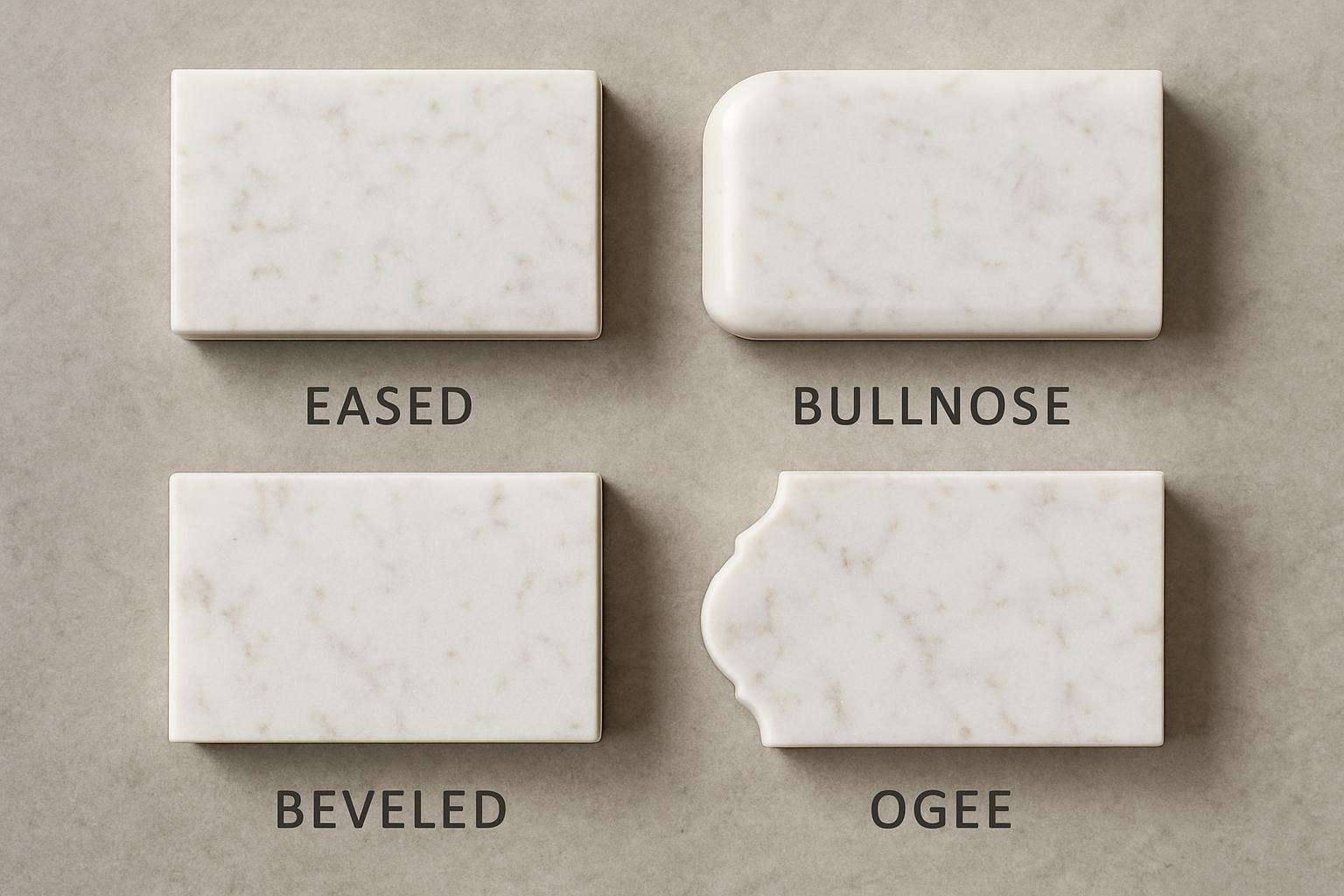
The eased edge is the most popular countertop edge in contemporary kitchen design. It’s essentially a square edge with the sharp top corner very slightly softened — just enough to remove the risk of chipping while maintaining a clean, architectural look. The eased edge is the default for modern and minimalist kitchens because it disappears visually, keeping all the attention on the stone material rather than the edge detail. It’s also the most forgiving edge to fabricate and refinish if damaged.
Beveled Edge
A beveled edge features a flat, diagonal cut at the top corner — typically at a 45-degree angle — that creates a gleaming facet along the front of the countertop. The bevel catches light beautifully and adds a subtle sense of precision and craftsmanship. It works equally well in contemporary and transitional settings, and it’s particularly attractive on darker stones where the angled facet creates a bright, contrasting highlight.
Waterfall / Mitered Edge
The waterfall edge is the most dramatic contemporary option. Created by joining two pieces of stone at a 45-degree miter, it gives the countertop the appearance of being three or four inches thick — or, on a waterfall island, allows the stone to flow continuously from the horizontal surface down the sides to the floor. The waterfall edge is the signature feature of luxury modern kitchen design and requires exceptional fabrication precision to execute correctly.
Rounded and Softened Edge Profiles
Bullnose Edge
The bullnose edge is fully rounded from top to bottom — both the top and bottom corners are curved, creating a smooth, semi-circular profile. It’s one of the most tactilely satisfying edges to run your hand along, and it’s among the safest options for homes with children because it eliminates all sharp corners. The bullnose is a classic choice for bathroom vanities and works well in transitional and traditional kitchens.
Half Bullnose (Demi Bullnose)
The half bullnose rounds only the top corner, leaving the lower portion of the edge vertical and square. It’s a popular middle ground between the crispness of an eased edge and the full roundness of a bullnose — friendly and safe without sacrificing the architectural definition of a vertical edge face. The demi bullnose is one of the most versatile profiles, suitable for contemporary, transitional, and traditional applications alike.
Decorative and Traditional Edge Profiles
Ogee Edge
The ogee edge is the most recognizable traditional countertop profile — an elegant S-curve that has been used in classical architecture and furniture for centuries. The upper concave curve flows into a lower convex curve, creating a graceful, layered silhouette. The ogee is most at home in traditional and formal kitchen designs with detailed cabinetry, raised panel doors, and ornamental hardware. On thicker slabs or mitered edges, the ogee takes on additional presence and grandeur.
Dupont Edge
The dupont edge features a stepped design — a flat upper surface with a quarter-round or decorative detail at the top, followed by a vertical face and a coved or rounded lower profile. It creates a sense of layered depth that reads as more substantial than a simple eased or bullnose edge, making it a popular choice for homeowners who want a decorative edge without the full formality of an ogee.
Cove Dupont Edge
A variation on the dupont, the cove dupont adds a concave cove detail to the upper portion of the edge. The result is a more intricate, layered profile with both concave and convex elements that catches light in multiple ways simultaneously. It’s one of the more ornate options available in standard fabrication and is most effective on lighter-colored stones where the shadows in the concave curves are clearly visible.
Choosing the Right Edge for Your Project
The best edge choice depends on your kitchen’s design vocabulary, the stone material you’ve selected, and how you use your kitchen. For contemporary kitchens with flat-panel cabinetry, simple profiles like eased, bevel, or mitered are almost always the right choice. For transitional kitchens with shaker-style cabinets, half bullnose or demi bullnose edges provide the right balance. For traditional kitchens with detailed cabinetry and ornamental hardware, ogee or dupont profiles complete the look.
Consider also the practical aspects: homes with young children benefit from rounded profiles that eliminate sharp corners; active cooks who lean heavily on the counter may prefer a thicker, more substantial edge; and homeowners who value ease of cleaning should note that more complex profiles have more contours to clean around.
Frequently Asked Questions About Countertop Edge Options
Does the edge profile affect the cost of my countertop?
Yes. Simple profiles like eased and half bullnose are typically included in base fabrication pricing. More complex profiles — ogee, dupont, cove dupont — require additional machining time and may carry an upcharge per linear foot. Mitered and waterfall edges involve additional material and significant labor, making them the most expensive edge options.
Can I use different edge profiles on different sections of my countertop?
Yes, though it’s generally most visually cohesive to use a consistent edge throughout a single room. Some homeowners choose a decorative profile on the island (which is most visible) and a simpler eased edge on perimeter countertops. Our team can advise on combinations that work well together.
Which edge profiles are easiest to maintain?
Simple profiles like eased and half bullnose are the easiest to clean and re-polish if they become dull or scratched. Complex decorative profiles with multiple curves and transitions are harder to clean thoroughly in the contours and more difficult to refinish if damaged.
Do edge profiles look different on different stone materials?
Yes — significantly. On stones with bold veining, decorative profiles can interrupt the natural pattern in a way that looks busy. On consistent-colored stones or stones with subtle patterning, decorative edges show their detail most clearly. Your fabricator can show you how a specific edge will look on your chosen material.
Can I see edge profile samples before deciding?
Absolutely — and we strongly recommend it. Seeing and touching edge profiles in person gives you a much better sense of the finished look than any photo. Contact Impact Countertops to visit our Columbus showroom and review our full selection of edge profile samples.



Leave a Reply