
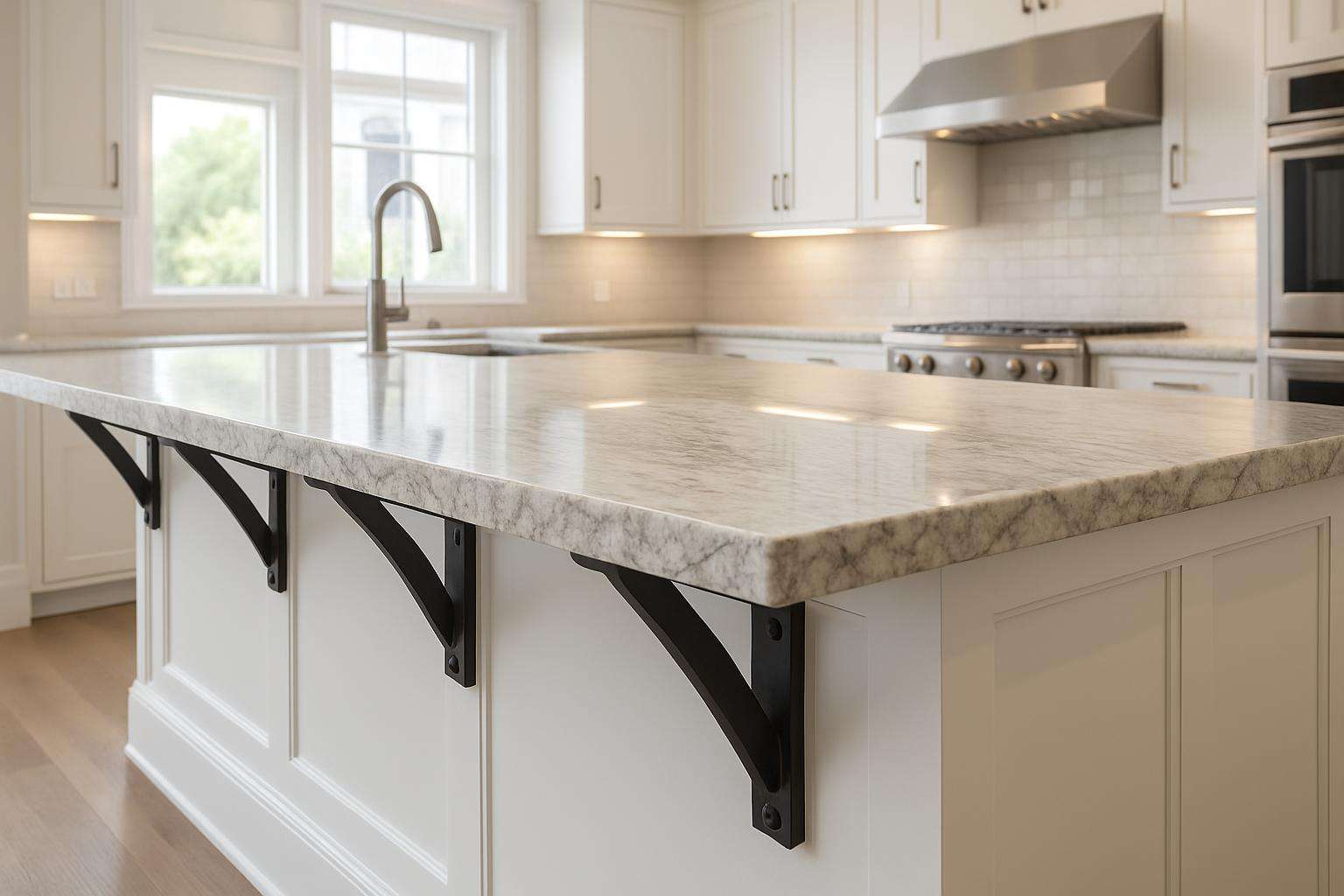
Stone countertops are heavy — and when you extend them beyond cabinet support to create a seating overhang, that weight needs somewhere to go. Countertop support brackets are the engineering solution that makes long, dramatic overhangs structurally safe without sacrificing aesthetics. Whether you are designing a kitchen island with bar seating, a peninsula with a 15-inch overhang, or a custom bar top, understanding how countertop support brackets work will help you plan a surface that is both beautiful and built to last.
When Are Countertop Support Brackets Required?
The general rule of thumb for stone countertops is that overhangs up to 6 inches typically do not require additional support — the stone’s own strength and the cabinet’s edge provide enough stability. Once an overhang extends beyond 6 inches, the brackets become necessary to prevent cracking, flexing, and eventual failure.
For seating at a kitchen island, a 12-inch overhang is standard (allowing knee clearance under bar height). Some designers extend to 15 or even 18 inches for a more generous seat depth. At these spans, properly installed countertop support brackets are essential — not optional.
Types of bracket supports
Flat Steel Brackets
Flat steel countertop support brackets are the most common and versatile option for modern kitchens. They are typically fabricated from 3/16-inch or 1/4-inch steel plate, either powder-coated black or left as natural steel, and mount flush to the cabinet side panel. Because they sit flat against the cabinet face, they are nearly invisible when seated at the counter — you see the stone overhang without any visible support hardware interrupting the line.
Flat steel brackets should extend a minimum of two-thirds of the overhang distance into the cabinet and be fastened to a structural element — a cabinet side panel, a dedicated cleat, or a wood backer — not just to drywall. Spacing should be no more than 24 inches on center for stone countertops, with brackets placed closer together on particularly heavy slabs.
Rod or Bar Brackets
Round steel rod brackets offer a more decorative profile, similar to corbels but with a sleeker, industrial aesthetic. They work well in contemporary and transitional kitchens where the bracket itself is meant to be seen as a design feature. Rod brackets are available in a range of finishes — matte black, brushed nickel, oil-rubbed bronze — that can coordinate with hardware and fixtures.
Corbels
Traditional corbels — in wood, wrought iron, or stone — are the classic countertop support solution for farmhouse, traditional, and transitional kitchens. They are decorative as well as functional and add architectural character to the space. The tradeoff is that corbels are visible and take up knee space, making them less practical for seating applications.
Full-Height Cabinet Panels
For very long overhangs or extremely heavy stone slabs, a full-height decorative panel — running from floor to countertop — can act as a structural column. This is common at the end of a peninsula and creates a finished, furniture-like appearance.
Sizing and Spacing Guidelines
Proper sizing and spacing of these hardware pieces is critical for stone countertop performance. Here are the guidelines our fabrication team follows.
Each bracket should extend at least two-thirds of the overhang distance back into the cabinet structure. So for a 12-inch overhang, each bracket should reach at least 8 inches back into the cabinet. Brackets should be spaced no more than 24 inches apart. For overhangs longer than 36 inches, consider spacing brackets every 18 inches. The fasteners anchoring the bracket to the cabinet must penetrate into solid wood — plywood, hardwood, or a dedicated structural cleat — not just into the cabinet’s face frame.
Working with Your Fabricator
At Impact Countertops, we discuss bracket requirements during the template phase of every project involving an overhang greater than 6 inches. We confirm bracket placement, spacing, and substrate before fabrication begins, so the countertop arrives knowing exactly where it will be supported. This prevents the cracking that can occur when a heavy stone slab is set on inadequate support.
For information on stone strength and structural considerations, the Natural Stone Institute publishes technical guidelines that fabricators follow industry-wide. Ready to plan your countertop overhang? Contact us and we will make sure it is done right.
Frequently Asked Questions
How many countertop support brackets do I need?
Space support brackets no more than 24 inches apart along the overhang. For a 48-inch island seating run, you would typically use three brackets — one at each end and one in the middle. Adjust spacing closer for heavier stone or longer spans.
Can I install brackets after the countertop is already in place?
In some cases, yes — if there is accessible cabinet space and the brackets can be positioned correctly. However, retrofitting brackets after installation is more difficult and requires temporarily supporting the stone. It is always best to plan bracket placement before the countertop is set.
Do brackets need to be embedded in the stone?
Most flat steel countertop support brackets sit under the stone and are secured to the cabinet. The stone rests on top of the brackets. In some commercial or extreme overhang applications, brackets are epoxied into routed channels in the underside of the slab, but this is not standard for residential kitchen overhangs.
What is the maximum overhang without support?
For 3 cm (approximately 1.25-inch) granite or quartzite, most fabricators consider 6 inches the maximum unsupported overhang. Beyond 6 inches, countertop support brackets are required. Thinner slabs and softer stones may require support at even shorter spans.




Leave a Reply