
When you invest in a stone countertop, you’re making a decision that will define the character of your kitchen or bathroom for years to come. But beyond the stone material itself — granite, marble, quartzite, quartz, or porcelain — one of the most underappreciated design choices is the edge profile. Custom countertop edge profiles are the finishing detail that can make a surface look sleek and modern, classically elegant, or boldly dramatic. At Impact Countertops in Columbus, Ohio, we offer a full range of edge profiles and work with every client to match the right edge to their stone, their cabinetry, and their overall design vision.
In this guide, we’ll walk through the most popular countertop edge profiles, explain the practical and aesthetic differences between them, and help you understand how to choose the right edge for your next project.
Why Edge Profiles Matter
A countertop’s edge profile is more than a finishing touch — it’s a design statement. The profile you choose affects how the countertop feels to the touch, how easy it is to clean, how it reflects light, and how it interacts visually with your cabinetry and backsplash. A thick, highly detailed ogee edge communicates traditional elegance. A thin, flat eased edge communicates contemporary minimalism. The same stone slab can look completely different depending solely on the edge profile applied to it.
Edge profiles also have practical implications. Rounded profiles like bullnose are softer and less likely to chip or cause injury in active family kitchens. Sharper, more detailed profiles like ogee or dupont show off the depth and color of thick stone slabs more dramatically. Understanding these trade-offs helps you make a choice that’s both beautiful and functional.
Popular Countertop Edge Profiles Explained
Eased Edge
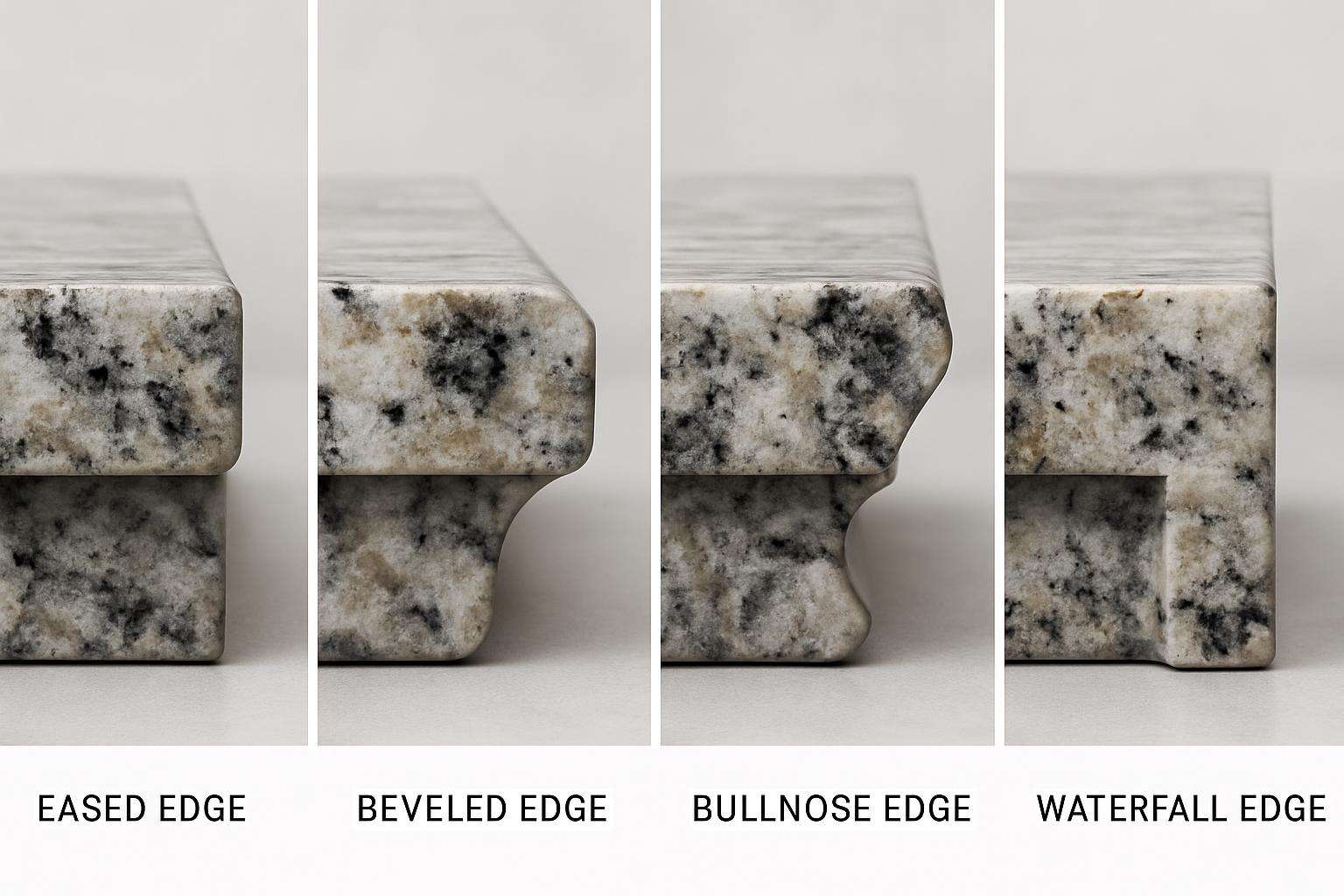
The eased edge is the most contemporary and minimalist option. It features a flat top and bottom with slightly softened 90-degree corners — just enough to remove the sharpness of a perfectly square edge without adding any curvature. The eased edge is the default choice for modern and transitional kitchen designs, pairing cleanly with flat-front cabinetry and simple hardware. It’s easy to clean, understated, and lets the stone’s surface do the talking.
Beveled Edge
A beveled edge features an angled cut along the top edge of the countertop — typically a 45-degree angle. The bevel creates a slight visual shadow line that adds dimension and interest without becoming ornate. It works well in both modern and transitional kitchens, and the angled face catches light beautifully on polished stone surfaces. Beveled edges are an excellent choice when you want something more visually interesting than a plain eased edge without committing to a more traditional profile.
Bullnose Edge
The bullnose edge features a fully rounded top edge that curves smoothly from the countertop surface to the underside. It’s one of the safest edge profiles for households with children and one of the easiest to clean, with no sharp corners or crevices. Bullnose works well in traditional, transitional, and casual kitchen styles. A half-bullnose variant — rounded on top but flat on the underside — offers a slightly more modern look while retaining the soft, friendly feel of the full bullnose.
Ogee Edge
The ogee is a classic, highly decorative edge profile featuring an S-shaped curve with concave and convex elements. It’s been used in traditional millwork and architecture for centuries, and it translates beautifully to stone countertops. An ogee edge communicates formal elegance and pairs naturally with raised-panel cabinetry, ornate hardware, and traditional kitchen designs. Because the ogee has more surface area to show off the stone’s depth and polish, it looks particularly stunning on thick slabs of marble, granite, and quartzite.
Dupont Edge
The dupont edge (also called a step edge or stair edge) features a flat top, a small step or notch partway down, and a vertical face below. This creates a layered, architectural look that adds visual interest and makes the countertop appear thicker than it actually is. The dupont edge works beautifully on islands and peninsulas where the edge is highly visible, and it pairs well with transitional and contemporary design styles that want something more distinctive than a simple eased or beveled edge.
Waterfall Edge
The waterfall edge is a design concept rather than a single profile — it refers to a countertop slab that extends vertically down the sides of the cabinetry to the floor, creating a continuous “waterfall” of stone from the countertop surface to the ground. Achieving a true waterfall edge requires precise mitering of the stone at the corner so the veining appears to flow continuously from horizontal to vertical surfaces. The waterfall edge is among the most dramatic and expensive countertop treatments available, and it’s become a signature feature in high-end kitchen design over the past decade.
Choosing the Right Edge Profile for Your Space
The right edge profile depends on your design style, the thickness of your stone, the height of your countertop, and how the space is used. Here are some general guidelines:
For modern and contemporary kitchens, eased, beveled, or dupont edges work best. Clean lines and minimal ornamentation define these styles.
For traditional and transitional kitchens, bullnose, ogee, or other decorative profiles add the warmth and detail these styles call for.
For family kitchens with young children, bullnose or half-bullnose edges minimize the risk of bumps and bruises from sharp corners.
For statement islands and peninsulas, waterfall edges or thick mitered edges with ogee or dupont profiles create a dramatic focal point.
At Impact Countertops, we walk through edge profile options with every client during the design consultation. We’ll show you samples and discuss how each profile looks on the specific stone you’ve chosen. Contact us in Columbus to schedule your countertop consultation today.
Frequently Asked Questions About Countertop Edge Profiles
What is the most popular countertop edge profile?
The eased edge is currently the most popular countertop edge profile, particularly in modern and transitional kitchens. Its clean, minimalist appearance suits a wide range of design styles and pairs naturally with both light and dark stone materials. Beveled edges are also very popular for those who want a bit more visual detail while maintaining a contemporary look.
Does the edge profile affect the cost of a countertop?
Yes. More complex edge profiles require more fabrication time and specialized tooling, which increases the cost. Simple profiles like eased and beveled edges are typically the most affordable. Decorative profiles like ogee and dupont cost more, and a waterfall edge — which requires precise mitering and additional stone — is the most expensive edge treatment. Your fabricator can provide pricing for specific profiles based on your countertop dimensions.
Can I get a different edge profile on different parts of my countertop?
Yes. It’s possible to use different edge profiles on different sections of a countertop — for example, a waterfall edge on the island end panel and an eased edge on the perimeter countertops. This approach requires careful planning to ensure the different profiles work together harmoniously. Discuss this option with your fabricator during the design consultation.
What edge profile works best for thick stone slabs?
Thick stone slabs — 1.5-inch or 2-inch mitered edges — look stunning with ogee, dupont, or waterfall profiles that showcase the stone’s depth. A thick eased or beveled edge on a mitered slab also creates a strong, architectural statement. For thinner 3/4-inch slabs, simpler profiles like eased or bullnose are generally more appropriate since there is less material depth to work with.
How do I choose an edge profile at Impact Countertops?
During your design consultation at Impact Countertops, our team will walk you through your edge profile options using physical samples. You’ll be able to see and feel how each profile looks on your chosen stone material. We consider your cabinetry style, the thickness of your slab, and your overall design vision to help you select the profile that best completes your space.




Leave a Reply