
Soapstone is one of the most distinctive and characterful natural stone countertop materials available — and one that rewards attentive care with a beauty that deepens and matures over time. Unlike granite or quartzite that are sealed to protect their porous surfaces, soapstone care revolves around a different product entirely: mineral oil and wax. Understanding how and why to apply these products is the key to maintaining a soapstone countertop that looks its best for decades. The Natural Stone Institute recognizes soapstone as a uniquely durable natural stone with a centuries-long history of use in demanding applications from laboratory countertops to kitchen sinks.
At Impact Countertops, we fabricate and install soapstone countertops for Columbus, Ohio homeowners who appreciate the material’s warm, matte character and unique personality. Contact our team to explore soapstone options and learn how we can create a custom installation for your home.
Why Soapstone Is Different from Other Natural Stones
Before diving into care instructions, it helps to understand what makes soapstone unique. Soapstone is a metamorphic rock composed primarily of talc — one of the softest minerals on Earth — along with chlorite, magnetite, and other minerals. Its high talc content gives it a smooth, slightly slippery feel (similar to soap, hence the name) and makes it completely non-porous. Unlike granite, marble, and quartzite, soapstone does not absorb liquids and never needs to be sealed.
Soapstone’s high talc content also makes it softer than most countertop stones — it scratches more easily than granite, which is part of its natural character. Scratches in soapstone are easily sanded out, and with regular oiling, the stone develops a rich patina that gives it an heirloom quality unlike any other countertop material. It is also completely acid-resistant — unlike marble, soapstone does not etch from acidic foods or household acids.
The Role of Mineral Oil in Soapstone Care
The most important care product for soapstone countertops is food-grade mineral oil — the same clear, odorless, tasteless oil used in cutting board care and as a mild laxative. Applying mineral oil to soapstone does not seal the stone (which is unnecessary since it’s non-porous) but instead darkens it to show its true, rich color and evens out the natural darkening process that occurs with use over time.
Without oil, soapstone in a new installation has a medium-gray, slightly lighter appearance. Areas of the stone that receive more handling and contact — around the sink, near the stove, high-traffic zones — will naturally darken faster than areas that are less frequently touched. This uneven darkening can make the countertop look blotchy or inconsistent during the first year or two of use. Regular oiling accelerates the darkening process uniformly across the entire surface, creating a consistent, rich, dark appearance that most soapstone owners prefer.
How to Apply Mineral Oil to Soapstone
Step 1: Clean the Surface
Before applying oil, clean the countertop thoroughly with a mild dish soap and warm water. Remove all crumbs, grease, and residue, then dry the surface completely with a clean cloth. Applying oil to a dirty or wet surface will trap contaminants beneath the oil and can create a streaky, uneven finish.
Step 2: Apply the Mineral Oil
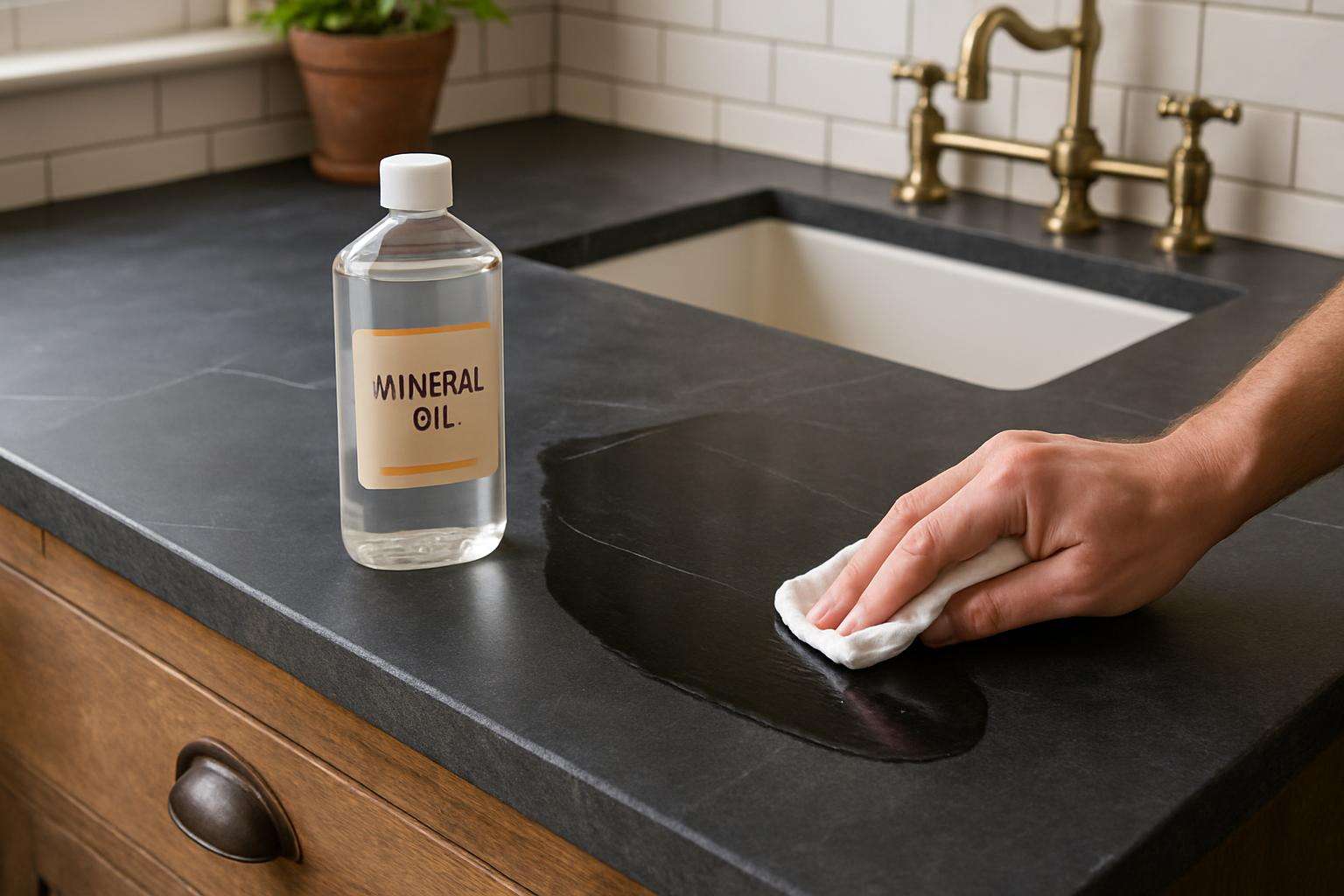
Pour a modest amount of food-grade mineral oil onto the countertop surface — enough to cover the area you’re working on without puddles. Use a clean, soft cloth (microfiber or cotton) to spread the oil evenly across the entire surface in circular motions, working the oil into every section including the edges and any areas around cutouts. The stone will visibly darken as the oil is applied — this is exactly what you want to see.
Step 3: Let It Absorb and Wipe Off Excess
Allow the mineral oil to sit on the surface for 15 to 20 minutes. The stone will absorb some of the oil, deepening in color. After the absorption period, use a clean dry cloth to wipe off any remaining excess oil. Do not leave excess oil on the surface — it can become sticky or attract dust if not wiped off. The finished surface should look richly dark and slightly sheen-like, not oily or wet.
Step 4: Repeat as Needed
In the first few months after installation, oiling every one to two weeks is typical as the stone absorbs oil and develops its patina. As the stone darkens and stabilizes, the frequency decreases naturally — most soapstone owners find they only need to oil every few months after the first year. You’ll know it’s time to re-oil when the stone begins to lighten in appearance or looks dry in certain areas.
Soapstone Wax: An Alternative to Mineral Oil
Some soapstone owners prefer to use beeswax or a commercial soapstone wax product instead of mineral oil, or alternate between the two. Wax provides a slightly longer-lasting protective layer than oil alone and can impart a subtle sheen to the surface. The application process is similar: apply a thin layer of wax, allow it to penetrate briefly, then buff with a soft cloth to the desired finish.
Wax is particularly useful for soapstone sinks and high-use areas where oil seems to wear away more quickly. Commercial soapstone wax products are available from stone care suppliers and some natural stone fabricators. Food-grade beeswax is also an excellent natural option. Avoid candle wax or paste waxes not specifically formulated for stone — these can leave residue and are difficult to remove.
Managing Scratches in Soapstone
Because soapstone is softer than most countertop stones, it scratches more readily — particularly from knives, keys, and abrasive objects. However, scratches in soapstone are one of its most forgiving characteristics: they are easily addressed with fine-grit sandpaper (220 grit or higher) followed by re-oiling. Light scratches often disappear entirely with re-oiling alone as the oil darkens the surface uniformly. Many soapstone owners come to appreciate the scratches as part of the stone’s evolving character — similar to the way a well-used butcher block or cast iron pan develops personality with age.
Frequently Asked Questions About Soapstone Countertop Care
Do I need to seal soapstone countertops?
No. Soapstone is completely non-porous and does not absorb liquids, so traditional penetrating sealers are unnecessary and ineffective. Mineral oil and wax are used to control and accelerate the natural darkening process, not to seal the stone against staining.
Can I use cooking oils instead of mineral oil on soapstone?
No. Cooking oils like olive oil, vegetable oil, and coconut oil will go rancid over time and create an unpleasant odor. Always use food-grade mineral oil, which is colorless, odorless, and does not spoil. It’s inexpensive and available at pharmacies and hardware stores.
How do I remove deep scratches from soapstone?
Deep scratches can be sanded out using 120 to 220 grit sandpaper, working with the scratch and progressively using finer grits until the surface is smooth. Follow with re-oiling to restore the darkened appearance. For very deep gouges, contact a professional stone restoration specialist or your fabricator.
Can soapstone countertops be used near a stove?
Yes — soapstone is exceptionally heat-resistant and can withstand direct contact with hot pots and pans without damage. This is one of the reasons it was historically used in laboratory settings and wood-burning stoves. You can set hot cookware directly on soapstone with confidence.
How do I get started with soapstone countertops in Columbus, Ohio?
Soapstone is a specialty material that not every fabricator carries or has experience working with. Impact Countertops has the expertise and slab access to deliver a beautiful soapstone installation. Contact our Columbus team to schedule a consultation and explore the soapstone varieties we have available.




Leave a Reply